




















































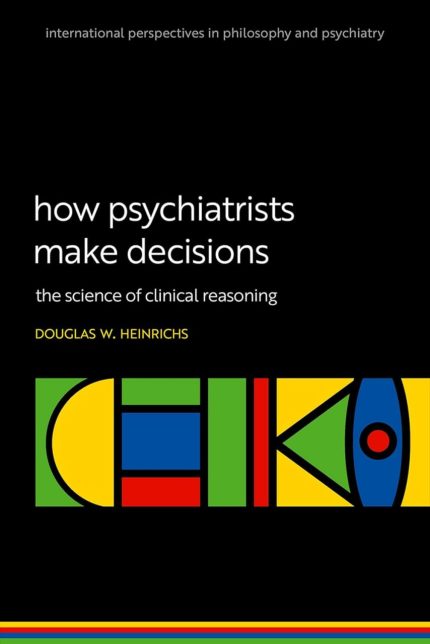
How Psychiatrists Make Decisions: The Science of Clinical Reasoning (International Perspectives In Philosophy & Psychiatry) (Orginal PDF from publisher)
In an age of scientific psychiatry and evidence-based medicine, the judgment of psychiatric clinicians in treating individual patients has often been devalued as the “art” of medicine, assumed to carry less evidentiary weight than research data. Clinicians are expected to apply findings from formal studies conducted on groups of patients—reducing the individual to a token of a diagnostic category. Yet the limits of research in guiding care for unique individuals demand clinical judgments precisely where formal guidance is lacking, even as these judgments are viewed as necessary but epistemologically suspect. This dilemma is reinforced by the tacit, largely unarticulated nature of clinical decision-making.
In this book, Heinrichs makes explicit the underlying methodology behind the clinical reasoning of experienced psychiatrists. Beginning with a detailed phenomenological analysis of specific cases, he argues that clinicians construct individualized models of patients—patterns of propensities and their interactions, known as POP models. These models allow for rational hypotheses about interventions, along with predictions that can be tested in practice. The book describes the characteristics and structure of this modeling process in depth.
By making these models explicit, clinicians gain tools to critically assess their own thinking. The approach also offers valuable applications for training psychiatric trainees, supported by recent cognitive-science research on how expertise develops in fields marked by ambiguity and complexity. The book provides specific recommendations for applying POP models in training environments to help novices progress toward expert-level reasoning.
Finally, the book challenges the notion that individualized clinical judgment is unscientific. It examines developments in the philosophy of science that move beyond the traditional hypothetico-deductive model toward a naturalistic understanding of scientific practice. Across disciplines, constructing models to represent concrete aspects of reality—and using them to solve specific problems—has emerged as a core scientific activity. POP modeling fits squarely within this framework. When understood and applied rigorously, clinical reasoning becomes a fully scientific process deserving significant epistemological credibility.
Join the leading minds in health. Discover essential reading at Ebookmedhub

Original price was: $201.00.$26.00Current price is: $26.00.
Original price was: $133.04.$35.00Current price is: $35.00.
Original price was: $118.75.$21.00Current price is: $21.00.
Reviews
There are no reviews yet.